


The removal of an asbestos roof in Australia typically costs anywhere from $50 to $110 per square metre, which means the total cost of asbestos removal for a regular house would range from $3,500 to $10,000. This wide margin exists due to four factors that affect the price, including the size of the roof, the condition of the sheets, the accessibility to the property, and the distance the material has to be transported to a licensed disposal site. Bonded asbestos cement roofing sits at the cheaper end. However, asbestos that has been damaged or degraded will drive the cost up due to the additional steps required.
If you’re in Brisbane and you’d rather have a real number than a range, AMJ can send a licensed roofer out to inspect your roof and quote it properly.
Cost per square metre
Asbestos roof removal services for bonded asbestos are usually quoted by removalist businesses at rates between $50 and $110 per square metre. A more realistic range for your quote on an uncomplicated job in Brisbane (with good accessibility conditions) is between $70 and $85.
Any price below $50 is highly suspicious. After paying for waste disposal fees, purchasing personal protective equipment, operating machinery, and employing labour, it is simply impossible to make money at these prices.
A standard residential roof
On average, a regular-sized three-bedroom house in Brisbane covers an area of around 150 to 200 square metres. If it is just the removal, it will cost you between $7,500 and $17,000, based on the pitch and the condition of your current sheets. Cottages tend to be less costly, at $4,000 to $6,000. Other more challenging roofs include Queenslanders and two-story houses with steep roofs, costing upwards of $15,000 to $20,000.
An asbestos garage roof
A detached single garage is usually 20 to 40 square metres of roofing. Allow for between $1,500 to $3,500 for removal, with the lower end of the scale applying only where there is easy access by stripping at ground level from a low ladder. A double garage or a carport with an extension would cost around $3,500 to $5,500. Typically, garages are priced as separate removals, and the whole job will usually be completed in one day.
What actually drives the price up or down
Roof size and pitch
Roof area translates to higher costs. However, the relationship is not linear. This means that a 250-square metre roof does not cost twice as much as a 125-square metre roof since mobilisation and disposal logistics remain pretty much the same, despite the differences in sizes.
Pitch is where the surprises hide. A steep slope will need suitable harnesses and edge protection, and also removal will be carried out at a slower pace in order to avoid sheet breakage. A 30-degree pitch will add an extra 15% to 25% in terms of cost compared to a flat roof.
Bonded vs friable asbestos
It is easier to remove bonded asbestos, which consists of the cement sheets covering many Australian houses built prior to the 1980s. Fibres are embedded in the cement, and as long as they do not crack apart, there is no problem taking them off in large sections with fairly standard PPE and containment.
Friable asbestos is something else entirely. Friable asbestos will crumble under hand pressure, dispersing microscopic fibres whenever something comes into contact with it. In this case, you would need a Class A licensed removalist, not a Class B, full negative pressure, constant monitoring of air by an assessor, decontamination facilities on-site, and improved waste management procedures throughout the process. The same-sized roof, friable rather than bonded, can cost between two and four times more.
Condition of the sheets
Sheets that have baked in the Queensland sun for 40 years often crack the second a crew tries to lift them. And once that starts happening, a bonded removal begins to behave like a friable one. The crew switches to wet methods, double-bags the broken material, and scales up containment to match.
We pulled a roof off a Paddington Queenslander a while back, where the sheets crumbled like dry biscuit the moment they were touched. A two-day job turned into four. If an assessor spots damage during the pre-works inspection, the quote will allow for it from the start. If it only shows up halfway through the job, you’ll get a variation.
Site access and storey height
The cheapest scenario is a single-storey home where the truck can park within 10 metres of the roof. Add a steep driveway, a narrow side passage, a few overhanging trees, or a second storey, and the price climbs with every one of those. Two-storey removals need taller scaffolding, more edge protection, and the work simply goes slower.
Worst case is no truck access at all. Think inner-city terraces with no rear lane. The waste has to be hand-carried to a kerbside skip, and that alone can add $2,000 or more.
Distance to the nearest licensed disposal facility
Most quotes won’t spell this one out, but it matters more than people think. Asbestos waste can’t go to a regular tip. It has to be transported to a licensed asbestos disposal facility. In South East Queensland, the main sites are Swanbank near Ipswich and Browns Plains, with a few others scattered about. If your house is in central Brisbane, a tipping run is quick. If you’re out in the Scenic Rim or up the northern Sunshine Coast, that round trip can eat half a day of truck time and a tank of fuel. A removalist who books trucks every week knows exactly what the haulage costs are for your suburb.
What’s included in a legitimate quote (and what isn’t)
Licensed removalist labour and PPE
The labour line covers the licensed removalist and crew, plus their disposable coveralls, P2 respirators, gloves and boot covers. Every set of PPE gets used once and then thrown out as asbestos waste. None of it is reused. On a typical residential job, PPE on its own comes to several hundred dollars across the crew.
Containment, decontamination and air monitoring
Bonded removals need ground sheeting, wet-down gear to keep dust down, and sealed bags for everything coming off the roof. Friable jobs go further: enclosures, negative-pressure units, and a licensed assessor on site running air monitoring. That assessor’s fee is separate from the removalist’s, and it usually adds $800 to $2,500, depending on how long the monitoring runs.
Tipping fees and hazardous waste transport
Disposal fees at Queensland’s licensed facilities currently sit around $300 to $500 per tonne for bonded asbestos, with minimum charges that apply even on small loads. A typical residential roof produces 1.5 to 3 tonnes of asbestos cement waste. Add truck and driver time for the round trip, and disposal on its own can account for $1,500 to $3,000 of your quote. It’s often the single biggest line item, bigger than people expect.
Clearance certificate
After a friable removal, a clearance certificate from an independent licensed assessor is mandatory before anyone can move back into the area. For bonded removal, it isn’t always legally required. A reputable removalist will offer one anyway, because it gives you documented proof the job was done properly. Budget $300 to $700 if it’s quoted as a separate line.
Hidden costs
Replacement roofing materials
Once the asbestos is off, your roof structure is exposed, and it needs new roofing on it the same day. That cost isn’t part of the removal quote. New Colorbond or Zincalume on a standard three-bedroom home runs $12,000 to $25,000 supplied and installed, on top of the removal. Roof size, pitch, the profile you pick, and the state of the structure underneath: the same variables that drive any roof replacement cost. It’s also exactly why combining removal with replacement under one contract almost always works out cheaper. More on that shortly.
Temporary accommodation if you need to vacate
For most bonded removals, you will likely be able to remain where you are, as long as you are not within the work area. When it comes to friable roofs, however, things are somewhat different. You may be asked to move out for a night or two while the area remains contained.
Council permits and notifications
When it comes to asbestos removal of over 10 square meters in Queensland, you have to use a qualified professional for asbestos removal and notify Workplace Health & Safety Queensland five days prior to the job commencing. Your asbestos removal company will take care of that for you. However, if there is some rebuilding involved in your project, then you’ll also need building permits from your council ($500-$2,000).
Insurance implications for known asbestos
The existence of asbestos shingles in your property should already have been considered in determining the amount of your premium payment. After you successfully remove these shingles and dispose of them, along with a proper certification showing their removal, contact your insurance company. It may be possible that you can reduce your premium a little bit. At any rate, it is better to have these certificates documented for future claims.
Removal on its own, or full replacement?
Removal without replacement only really makes sense in a couple of situations. If you’re demolishing the structure and rebuilding, removal on its own is fine because the new roof is part of the rebuild. Same answer if you’ve got a small outbuilding you no longer need and you’re happy to leave it roofless. Outside those cases, leaving a home without a roof for any length of time creates problems you really don’t want.
Why most Brisbane homeowners are better off combining removal with a new metal roof
For a standard home, the smart move is to book the asbestos removal and the new metal roof as one project, with one contractor. The reason is simple. The economics just work out better.
You pay for scaffolding and edge protection once, not twice. The crew stays on site continuously, so the old roof comes off in the morning and the new sheets start going on that same afternoon, with the house properly sealed by knock-off. There’s no weather-exposed gap between two separate trades. There’s one point of accountability if something goes wrong. And because the work runs straight through, the labour cost comes in lower than two separate bookings.
AMJ does it this way as standard. We’re a BlueScope Steel partner, so the Colorbond roofing in Brisbane (or Zincalume) going on after removal carries up to a 45-year manufacturer warranty on eligible products, backed by our own 10-year workmanship warranty on the install. You finish the project with a fully compliant new roof and documented proof of safe asbestos disposal. One job, not two, that might not line up.
What a combined removal and replacement typically costs
For a standard Brisbane three-bedroom home, a combined asbestos roof removal and replacement with a Colorbond re-roof usually lands between $18,000 and $32,000, and that figure covers everything: removal, disposal, new roofing materials, installation, scaffolding, edge protection and clearance documentation. The variation comes down to roof size and complexity, any insulation upgrades, and whether the battens and structure need work once the old sheets are off. Bigger or more complex homes go higher.
Why “cheap” asbestos removal quotes cost more in the end
Anyone can call themselves an asbestos removalist. Not everyone is licensed, insured, or actually planning to take your waste to a licensed disposal facility. Here’s what those bargain quotes are usually hiding.
Unlicensed operators and uninsured services
Removing more than 10 square metres of bonded asbestos in Queensland legally requires a Class B asbestos removal licence. Friable requires Class A. An operator without the right licence is committing an offence the moment they touch your roof, and their work won’t be accepted by your insurer, by your conveyancer if you sell, by WHS Queensland if there’s an incident, or by a future buyer doing their homework. And if an uninsured removalist has an incident on your property, you’re the one exposed to claims that should have been theirs to cover.
Illegal dumping and the liability that lands on the homeowner
Disposal is one of the largest costs in a legitimate removal. So when an operator quotes well below market rate, the maths often only adds up if they skip the licensed facility altogether. Illegally dumped asbestos has been traced back to homeowners before, more than once. If your name is on the contract and the waste turns up in a state forest or on a vacant block, you can be dragged into the investigation, no matter who actually tipped it there.
What to check before signing any quote
Before you sign, ask for:
- The removalist’s QBCC asbestos removal licence number and class (A or B), then verify it yourself on the QBCC online register
- A current public liability insurance certificate, with asbestos work specifically named in the cover
- Confirmation of which licensed disposal facility they use, and whether you’ll get tip receipts after the job
- Whether a licensed assessor is engaged for air monitoring, which is mandatory for friable and recommended for damaged bonded
- A written clearance certificate at the end of the job
A legitimate removalist hands all of this over without blinking. Anyone who gets cagey about their licence number, or won’t put their disposal facility in writing, is telling you something. Listen to it.
Brisbane and Queensland-specific cost factors
Local tipping fees and licensed disposal sites
Queensland’s licensed asbestos disposal facilities are clustered in the south-east corner. Swanbank, west of Ipswich, takes most of Brisbane’s asbestos waste, and current fees there are around $400 per tonne for bonded material, plus a minimum load charge. Browns Plains and a handful of regional sites cover the rest. Tipping fees in Queensland are broadly in line with Sydney, but higher than in rural areas, where smaller landfills take asbestos at lower rates.
Queensland WHS rules that affect pricing
Queensland enforces the Work Health and Safety Regulation 2011 strictly on asbestos work. WHS Queensland requires five business days’ written notice before any licensed removal of more than 10 square metres begins. Crews have to follow set decontamination procedures, and the asbestos itself has to be wet down, sealed and carried in covered loads. None of that is optional, and all of it adds time and cost. Any quote that claims to skip these steps to save you money is waving a red flag.
Why Brisbane quotes sit higher than regional QLD
A licensed removalist in Brisbane carries the same compliance overhead as one in a country town, but with higher labour rates, pricier tipping, and longer drives across the metro area. Removalists working out of Toowoomba or the Sunshine Coast hinterland often quote lower per-square-metre rates because their overheads are smaller, though many add a travel premium to come into Brisbane. For a Brisbane home, a Brisbane-based licensed roofer usually works out cleaner. They already know the local disposal facilities, the council requirements, and the access quirks of the suburbs they work in every week.
How to get an accurate quote for your roof
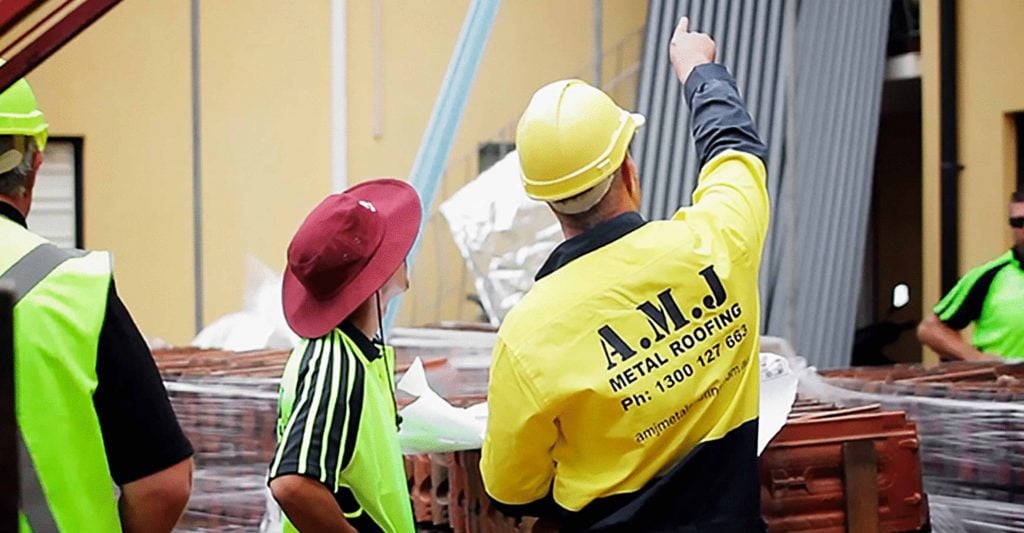
Online price ranges are handy for budgeting. But the only way to know what your roof will actually cost is an on-site inspection by a licensed roofer who can see the condition of the sheets, measure the area properly, and check the access.
When AMJ inspects an asbestos roof, we go up onto it, safely, measure it, photograph the state of the sheets, check the structure underneath, and flag any access challenges that will affect the price. Then we put together a written quote covering removal, disposal, the clearance certificate and the new metal roof, all as a single line of work. The inspection is a paid service, but we deduct it from the project price if you go ahead with us. And the quote we hand back is fixed, not a “from” price that quietly creeps up later.
If you’re in Brisbane, the Gold Coast, Ipswich, Toowoomba or the Sunshine Coast, give us a call on 1300 12 ROOF (1300 127 663), and we’ll get an inspection booked in.
FAQs
Can I remove an asbestos roof myself in Queensland?
Provided that it is below 10 square metres of bonded asbestos, but we still wouldn’t advise this course of action. If you want to have anything above 10 square metres removed from your property, then it must be done by a professional. Doing it yourself would leave you without a clearance certificate, insurance, disposal records, or anything for a new buyer to see.
How long does asbestos roof removal take?
A standard residential bonded asbestos roof takes one to two days to remove. Combine it with a new metal roof, and the full project usually runs three to five days, depending on size and weather. Friable jobs take longer because of the extra containment, decontamination and air monitoring.
Do I need a clearance certificate after removal?
For friable removal, yes. It’s a legal requirement before anyone can move back in. For bonded asbestos, it isn’t always mandatory, but it’s strongly recommended. The certificate is documented proof the work was done properly, and it’s often asked for by insurers, conveyancers, future buyers and even some lenders.
Does home insurance cover asbestos roof removal?
Rarely, but only if you are looking at it as a deliberate upgrade. It might include removal if there is damage to an asbestos roof due to some insured event (such as a storm or fire) requiring its removal for repair. Consult your insurance contract for specifics and discuss with your insurer.
What’s the cheapest way to deal with an asbestos roof?
The most economical approach would be a combined solution involving the removal and a new metal roof installed in one go, because you do not have to bear any extra charges for mobilisation and setting up of scaffolding. Hiring an unlicensed person, or even omitting the process of paperwork, can turn out to be more expensive than expected in the long run due to other issues arising.
How do I know if my roof actually contains asbestos?
Most Australian homes with cement sheet or corrugated cement roofing built before the mid-1980s contain asbestos. The only way to be sure is lab testing of a small sample taken by a licensed assessor. You can’t tell by looking, because newer fibre cement products look much the same but use cellulose fibres instead. If your home is from that era and roof work is on the cards, get it tested first. A pre-purchase or pre-works roof inspection is the standard way to do that.


