


The exact rules depend on what you’re replacing, how much of it, where you live, and what your roof is made of, but the general rule is that anything classed as a full roof replacement counts as building work and needs sign-off from a private building certifier. If you’d rather not deal with the paperwork yourself, AMJ can handle the approval process as part of your quote.
The short answer
If you are going to replace more than 20% of your old roofing material, you will require building approvals. This applies in every state, but the process differs. Small roof repairs do not require any approval. It’s just when you start working on a larger job that you must get your building approval.
This problem mostly arises from the use of the term “council.” Roofing projects, in most cases, don’t need approval from the council, but rather from building certifiers acting on behalf of the council.
When council approval is required for a roof replacement
You’re replacing more than 20% of the existing roof area
The 20% rule serves as the trigger point in the majority of the states in Australia, which includes Queensland through the City Plan and Building Code of Australia. Once you cross that line, the job stops being maintenance and becomes building work in the eyes of the building code.
It doesn’t matter whether you’re replacing 25% or the entire roof. Anything greater than 20% will require a development application or a building approval (based on which state you belong to). The private certifier will process the application and provide an approval in about a week or two.
You’re changing the roofing material
The best example of this is switching from tiles to metal. The different load requirements mean that the inspector must check whether the frame will be able to carry the material. Most of the time, the answer is yes, but it must be done nonetheless. For a detailed tile vs Colorbond comparison, the structural and performance differences between the two materials are worth understanding before you commit.
This applies even if you’re only replacing a small portion of the roof. A material change is treated as a structural decision, not a maintenance one, so the percentage rule doesn’t get you out of it.
You’re making structural changes to the roof
Anything that alters the shape, pitch, or framing of the roof needs approval. That includes raising the roofline, adding skylights that require cutting through rafters, changing from a hip to a gable, or extending the eaves. The certifier will want approved plans showing what’s proposed and how it complies with Australian Standards.
Your property is heritage-listed or in a conservation area
The heritage guidelines lie above the normal building approvals process. If your property is listed under the state heritage list or the designated conservation zone by the council, you will have to get the necessary heritage approvals before any building approvals can be granted. This process may take weeks, and it’s best to check the status of your property before proceeding.
When council approval isn’t required
Like-for-like repairs and routine maintenance
Replacing some sheets with the same material, repairing the leaking roof, tightening up any loose flashings, and fixing part of the gutters fall under the maintenance category. You do not need an authorisation for this because you are only maintaining the structure. AMJ does plenty of this kind of metal roof repairs work, particularly after hail or wind events where only part of the roof is affected.
Replacing fewer than 20% of roof sheets or tiles
Remaining below the 20% limit will ensure that the job remains an exempt one, as long as you still use the same material. As soon as the material is changed, or once you go over the limit, you’re again in approval territory.
Council approval versus building approval
Approval from the council, or in other terms, the “Development Application”, relates to the legality of your project under local planning regulations. Some considerations may include zoning, heritage, overshadowing, and setbacks. However, when replacing a roof, you will not require this approval, as changing the roof does not affect the nature of your construction.
Building approval deals with whether the work itself meets the building code. This is where the private certifier gives approval. It states that the design, material used, method of construction, and final installation have complied with Australian Standards and National Construction Code. In the case of roof replacement, this is the approval required.
The plumbing approval is a completely different matter in itself, and that is the case when there needs to be a change or an extension of gutters or downpipes that are connected to the stormwater drainage system. This is normally associated with roof replacements.
Who is responsible for getting the approval?
In terms of legal responsibility, it is the responsibility of the property owner to ensure that everything gets sorted out accordingly. In practice, the contractor will handle everything on your behalf. The Queensland Building and Construction Commission has made it clear that this must be indicated beforehand in the contract.
If the quote does not mention building approval, be sure to ask. Any good roofing business should either incorporate that into its costs or directly inform you that you need to do that yourself. This is your own responsibility since you may face the consequences of not doing it.
AMJ handles the approval process as standard on full re-roofs. That includes engaging the private building certifier, lodging the relevant forms, managing the inspections during the build, and arranging the final sign-off. You get a stamped certificate at the end confirming the work complies.
What the approval process actually looks like
Engaging a private building certifier
The certifier will be an independent building surveyor who will compare the proposed works with those provided for in the building regulations. The certifier will study the drawings, materials to be used, structure, and the fixing requirements. When dealing with the re-roofing of standard roofs that use Colorbond or Zincalume, the assessment process will be fairly simple.
It will also be verified that the work proposed is done according to the specifications of the manufacturer, ensuring that the BlueScope Steel warranty remains in force (45 years for certain products). All discrepancies with the specifications are raised prior to starting work.
The forms involved (Form 15, Form 16, Form 21)
In Queensland, three forms typically come up during a roof replacement.
- Form 15 is the design certificate. It confirms the proposed work has been designed to comply with the building code. For a re-roof, this usually covers the structural and waterproofing aspects.
- Form 16 is the inspection certificate. The certifier issues this at key stages of the build, confirming the work has been inspected and meets the approved plans.
- Form 21 is the final certificate of classification or final inspection certificate. This is the document that proves the building work is complete, compliant, lawfully done, and ready for the records. You’ll want this on file for insurance and resale purposes.
Other states use different forms but follow the same general pattern: a design certificate at the start, inspection certificates during the build, a final certificate at completion, and supporting documentation kept on file.
Final inspection and certification
The certifier returns at the end of the job to confirm the work matches the approved plans and complies with Australian Standards. If everything checks out, they issue the final certificate. If something’s off, they’ll flag it for rectification before signing off. Reputable roofers don’t have these issues because the work was done to spec from the start.
Roof replacements after a storm or insurance claim
The QBCC has confirmed that insurance-funded roof replacements are still building work and still require the same approvals as any other re-roof. The fact that an insurer is paying doesn’t change the building code. If the claim involves replacing more than 20% of the roof or changing the material, the approval has to happen.
The problem lies in the fact that insurance adjusters and contractors will try their best to complete the project quickly in order to settle the claim. Forgoing the paperwork to save yourself a week sounds like a smart idea at the time, but the trouble comes later when you find out that the insurance company has paid for the claim, while the contractor has gone into hiding.
If you’re going through an insurance claim, ask the contractor directly whether building approval is included in their scope. AMJ has long-standing relationships with major Australian insurance companies and handles the approval as part of every storm damage and insurance repairs job we take on.
What happens if you replace your roof without approval?
Fines and penalties
In Queensland, failure to obtain approval prior to undertaking construction may result in fines running into thousands of dollars. Enforcement notices may also be issued ordering that the work be corrected or demolished. The QBCC may take action on the licence of the constructor if the work was undertaken knowingly.
Voided home insurance and warranty issues
If your home insurance policy requires that any building work on the property is approved and compliant (most do), an unapproved roof can void your cover. If a storm damages the new roof and you make a claim, the insurer can refuse to pay because the work was unlawful.
The same applies to the roofer’s workmanship warranty and the manufacturer warranty on the roofing material. BlueScope’s product warranty assumes the installation meets specification, which is what the approval process confirms. Without that paper trail, you may not have the warranty you think you have.
Problems when selling your property
If you decide to sell your home, the buyer’s lawyer will ask for proof that there are no problems related to building regulations. This can become a sticking point in negotiations if the buyer realises that there hasn’t been any authorisation of a significant roof repair. It is sometimes possible to apply for a retrospectively approved repair, although this is a costly process.
How approval requirements differ across Australian states
The 20% rule is broadly consistent, but each state has its own variations. In Queensland, building approvals are handled by private certifiers under the Building Act. The local council (Brisbane City Council uses the City Plan) sets the planning framework, but the certifier issues the actual approval. The same applies in most metropolitan and regional councils across the state.
In New South Wales, the equivalent threshold sits in the State Environmental Planning Policy (Exempt and Complying Development Codes). Like-for-like replacements often qualify as exempt development, but a full re-roof or material change typically requires a complying development certificate, issued by a private certifier or the council.
In Victoria, the Building Regulations require a building permit for any work that affects the structural integrity of the roof, including replacement of more than 10 square metres of roofing in some cases. The threshold is lower than Queensland’s percentage-based rule, so smaller jobs can still require approval.
In South Australia and Western Australia, similar percentage-based or area-based rules apply, with the assessment usually handled by a private building surveyor. Tasmania and the ACT each have their own variations, and the Northern Territory adds another layer of its own. The principle stays the same: full re-roofs need approval, minor repairs don’t.
If you’re outside South East Queensland, check with a local certifier before assuming what does and doesn’t need approval in your area.
Speak to a roofer who handles the approval paperwork for you
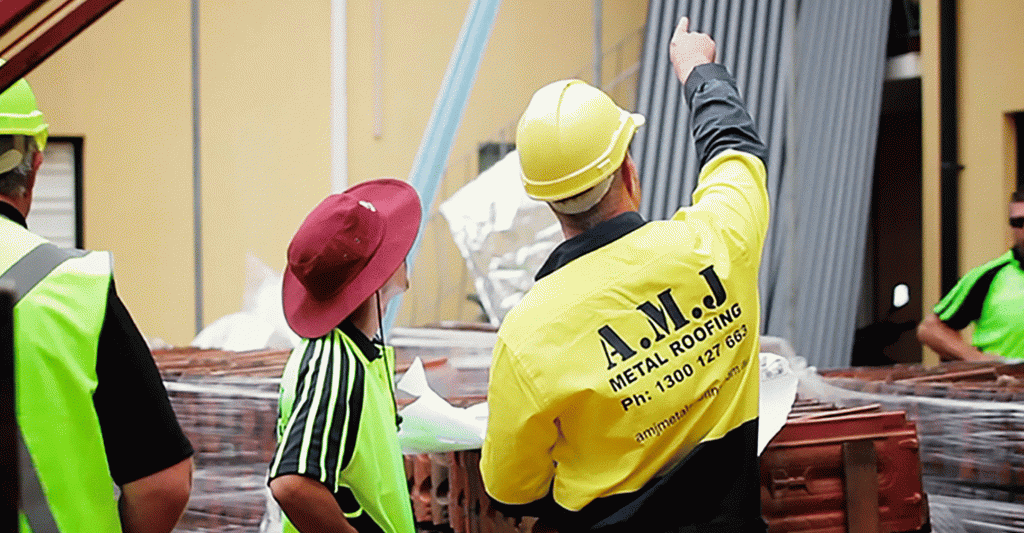
The simplest way to avoid getting tangled in the approval process is to use a roofer who handles it as part of the quote. AMJ Metal Roofing Brisbane has completed over 7,000 re-roof projects across South East Queensland and manages the certification process on every full replacement. You get a fully approved, compliant roof with the documentation to prove it, plus a 10-year workmanship warranty on the install. Call 1300 12 ROOF or request an inspection to get the process started.
FAQs
Do I need council approval to replace a tile roof with metal?
Yes. This change would be considered structural because you’re altering the roofing material. Therefore, you must get building approval regardless of the fact that you are not changing the actual design of the roof. The certifier will examine whether the current framework is able to carry the new material; in most cases, it will be able to do so.
Does replacing my roof after storm damage need approval?
Yes, but only when more than 20% of the roofing is to be replaced or the material is different. The QBCC has clarified that roof replacements done using insurance money fall under the same regulations as any other roofing job. Insurance money does not exempt you from complying with the building regulations.
Can I get retrospective approval for a roof that was replaced without one?
Occasionally. The certifier can examine the current installation and give a certificate if it is up to building codes, but all of this takes time and effort. Moreover, it is not a guarantee that it will be approved. It will take longer and cost more money compared to getting the approval beforehand.
Do solar panels on a new roof affect the approval process?
Yes, that’s possible. When the installation of solar panels is done along with the re-roofing of the house, the certifier will be interested to see how the solar panels will be installed and if the structural loading has been considered. Normally, the solar panels will require a separate approval, but it’s better to arrange them together.
How long does roof replacement approval take in Australia?
For a standard re-roof, building approval through a private certifier typically takes one to two weeks from lodgement. Heritage properties, structural changes, council referrals, or unusual roof designs can push that out to four to six weeks. Most jobs AMJ handles are approved within ten business days.


