

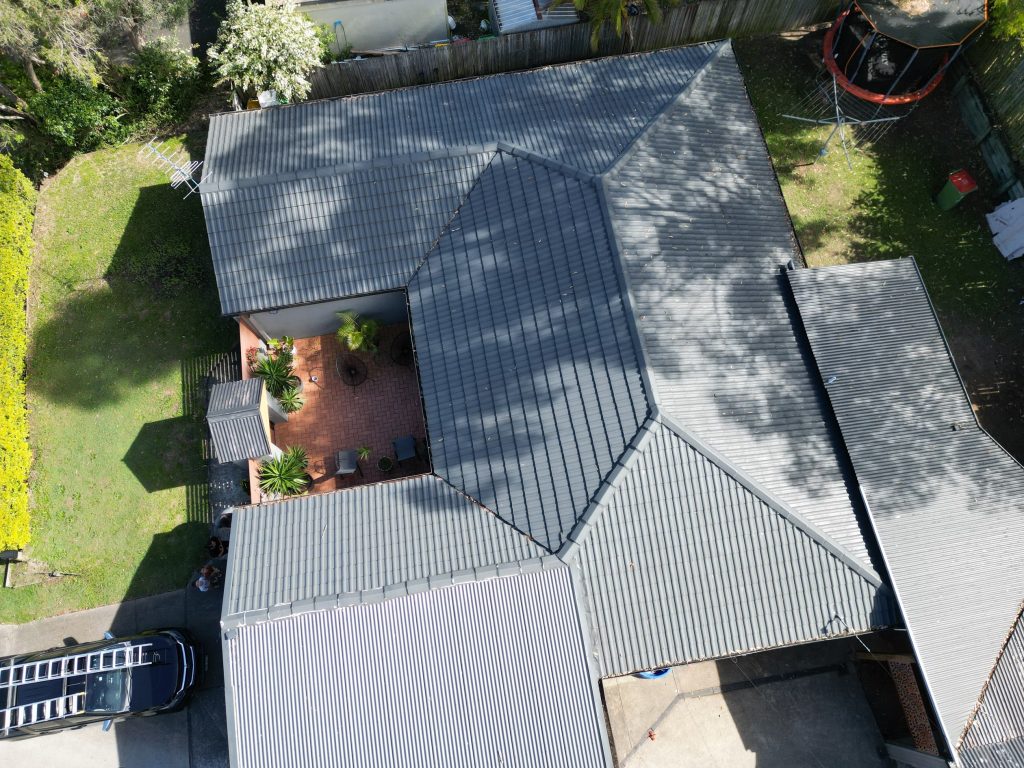
In Australian tax legislation, the replacement of an entire roof of a building is usually considered a capital improvement and cannot be claimed immediately in the tax year in which it is incurred as an allowable expense. The way in which it can be claimed depends largely upon the particular property being used, the nature of the construction carried out, the scope of the project, as well as its completion date.
If you’ve got a re-roof on the cards and want a quote that itemises the work properly for your accountant, give AMJ a call on 1800 901 409.
The short answer
The Australian Taxation Office makes a distinction between repairs and maintenance, which are actions taken to restore an asset back to its original condition, and capital works, which are improvements or replacements of the entire asset. Replacing an entire roof clearly constitutes capital work since you’re replacing the roof and not repairing or maintaining the existing one.
For investment property owners, this means that the cost will be claimed as a capital works deduction at a rate of 2.5% per annum for a period of 40 years, not a full write-off for the entire amount in one shot. In the case of owner occupier’s, although it won’t help you save on taxes annually, it will increase the cost base of the property.
Capital improvements vs repairs and maintenance under the ATO
The workmanship test for the ATO is derived from the ruling on Taxation TR 97/23. In repairing an asset, it returns to its original working condition without altering its nature. Capital improvements, however, completely replace or improve upon the old asset.
Repairing a few cracked tiles that got blown off by a storm is an example of repair work. Repairing only part of the metal sheeting because the whole thing hasn’t yet fallen apart would normally also be repair work. Tearing down the entire roof and installing a new roof is capital expenditure, end of story. It doesn’t matter to the Australian Tax Office whether your old roof leaked, was falling down, contained asbestos or had just reached the end of its life; once it’s replaced, you’ve acquired a new resource.
This is important to investors because costs of repair and maintenance are fully deductible immediately from the income earned during the year when they were incurred. Capital improvements, on the other hand, take a while. A single project that costs $30,000 could either lower your current-year tax bill by $30,000 or reduce it by $750 annually for the next 40 years.
How the 2.5% over 40 years depreciation works in practice
Capital works deductions are set at a flat 2.5% per year of the construction cost, claimable for 40 years from the date the work was completed. For example, if your roof replacement amounted to $40,000, then this would be $1,000 annually.
The forty years start after the project is completed and not when you purchased the property. You can sell the asset before the forty years are over, and the next buyer will continue the remaining years on the same basis as you, provided that they have your cost information.
The deduction sits under Division 43 of the tax act. It runs in parallel with plant and equipment depreciation, which is a different thing again.
When capital works deductions apply vs plant and equipment depreciation
Capital works refers to the structural components of the construction, such as walls, slabs, the roof structure, fixed wall cladding, and fencing. Plant and Equipment Depreciation, in Division 40, pertains to the removable assets, including hot water systems, blinds, carpets, and air conditioners, which have their respective effective lives according to the ATO.
The roof itself, along with its components like the sheeting, battens, fascia, and guttering, (which are a part of the building’s structure), is a capital work. That’s why the 2.5% rate applies rather than a faster depreciation schedule.
This becomes important where there are both structural and non-structural components listed on a detailed invoice. A whirlybird vent attached to the roof may form part of the plant and equipment. The metal sheeting below this constitutes capital works. Your accountant will need to be able to distinguish between the two using documents issued by your roofer.
When roof work is a repair and when it tips into a capital improvement
Replacing broken tiles or a damaged section
Storm damage, a fallen branch, a section of rusted sheeting on a Zincalume roof that’s otherwise still in service. If we come out and replace 20 broken tiles, re-bed a section of ridge capping, cut out and replace 30 square metres of rusted-through sheeting, or refit a stretch of flashing, that’s a repair. The character of the roof hasn’t changed. You’ve still got the same roof, just with the broken parts fixed.
For an investment property, this is immediately deductible. Keep the invoice, keep the photos, and your tax agent can claim the lot against rental income that year. If the damage came from a storm or hail event, the work may also be covered under your home insurance policy, and our team handles storm damage and insurance repairs directly with your insurer to take the friction out of the claim.
Re-roofing the whole house
The moment we strip the entire roof and replace it, the job tips into capital improvement territory. It doesn’t matter if the new roof matches the old one in material, profile, colour and pitch. You’ve replaced the entire asset, and the ATO treats that as capital works, no matter how like-for-like the replacement is.
This is the trap a lot of homeowners walk into. They assume “I had to do it because the old roof was failing” makes it a repair. The reason for the work doesn’t change the classification. The scope does. If you’re not sure whether you’re at the point of full replacement, our guide to the signs your home needs a roof replacement walks through the indicators that usually push a job from repair territory into a full re-roof.
Upgrading materials during a repair
Practically, it can be a smart decision. Tax-wise, it depends on how big the upgrade is. The ATO accepts that modern materials can be used in a repair even when they’re a slight improvement on what was there, provided the benefit is only minor or incidental. Like-for-like with a contemporary product is usually still a repair. A meaningful upgrade is not.
Going from a section of failing terracotta tiles to a Colorbond steel section is a clear upgrade. The new material has a substantially longer expected life and different performance characteristics, so that portion of the work generally falls on the capital improvement side. Swapping thin-gauge sheeting for a heavier gauge with no other change is closer to the grey area and worth a conversation with your accountant before the job is invoiced.
Our Colorbond vs tile roof comparison lays out the performance and lifespan differences that make this upgrade so common, and explains why the new material almost always counts as an improvement rather than a like-for-like replacement.
You can still do the upgrade. You just need to know that part of the cost is now claimable proportionally over 40 years rather than deducted immediately. A scope that separates the like-for-like portion from the upgrade portion gives your accountant the option to split the claim.
Initial repairs after purchasing the property
In the event that you purchased a property where the roof was already damaged at the time you bought it, all activities undertaken to address the pre-existing condition will qualify as an “initial repair.” Initial repairs cannot be deducted from taxes right away, despite being classified as repairs.
The ATO’s view is that you bought the property knowing it needed work, and the price you paid reflected that. So the cost gets added to the capital works pool and claimed at 2.5% over 40 years, not against rental income in year one.
Buy a place and have the roof fail six months later because of a storm, and that’s a different conversation. The damage happened on your watch, the property was income-producing, and a metal roof repair claim is on the table. The timing and the cause are both important.
How material and scope choices affect your tax position
Like-for-like replacement vs material upgrade
Although the like-for-like roof replacement is capital, the wording in the invoice is clear. We are simply replacing the old roof with another of the same material. The wording leaves nothing for your accountant or quantity surveyor to misinterpret.
A material upgrade introduces a question the ATO will sometimes ask, particularly on larger jobs. Was this work an improvement or a replacement? On an entire roof, this rarely changes the outcome, because the whole thing is capital works anyway. On a partial job, it changes everything.
Switching from tile to Colorbond steel
Going from concrete or terracotta tiles to a Colorbond steel roof is one of the most common upgrades we do, and it’s almost always categorised as a capital improvement on an investment property, even when the old roof was past saving. The new roof is lighter, longer-lasting and weather-tested to a higher standard than the original. A full Colorbond roof installation in Brisbane involves stripping the old tiles, adjusting the roof structure to suit metal sheeting, fitting new battens and flashings, and replacing the guttering. All of it sits on the capital works side of the ledger.
For your tax position, that means the full cost of the job sits in the capital works bucket: removal of the old tiles, structural adjustments to suit the new sheeting, any battens or insulation installed at the same time, and disposal fees. Nothing about this work is immediately deductible.
The upside is a longer-term claim. A 40-year deduction schedule on a roof that will outlast the schedule itself, with no maintenance costs eating into your rental income along the way.
Adding insulation, ventilation or sarking at the same time
If we install an anti-condensation blanket, sarking, whirlybird vents or in-line ventilation as part of the re-roof, those items get bundled into the total job cost. Most of it falls under capital works, because it’s attached to the building’s structure. Some of it, like motorised vents or solar-powered whirlybirds, may be treated as plant and equipment with a shorter effective life and a faster depreciation rate.
The benefit of doing this work at the same time as a re-roof is the lower cost compared with doing it separately later. Combining a re-roof with roof insulation work means the Anticon blanket and sarking go on while the sheeting is off, which is the only time they can be installed without a separate strip-off. The tax treatment of these items is worth discussing with your accountant before we finalise the scope, because they may want certain components invoiced separately to claim them under different rules. The same logic applies to a roof ventilation system, where some items are structural, and others are plant and equipment.
How a BlueScope manufacturer warranty signals a capital improvement
The ATO’s test for a capital improvement looks at whether the work has extended the useful life of the asset beyond its original condition. A 45-year BlueScope manufacturer warranty on eligible Colorbond products is direct evidence of that extended useful life.
When you replace an end-of-life roof with a Colorbond steel roof warranted for up to 45 years, you’re not restoring an asset to its previous condition. You’re putting on a roof that, on paper, has a longer effective life than the building’s original roof ever had. That’s the test, and the warranty document satisfies it.
The warranty certificate becomes valuable documentation for a quantity surveyor who needs to compile a depreciation schedule because it gives important details like the year of construction, the type of product involved, the expected life of the item, and its installation date. The warranty documentation should be kept among your tax documents, not in your kitchen drawer!
What the ATO and your accountant need from your roofer
A scope of works that separates repair items from improvement items
If the job includes anything that could reasonably be classified as a repair alongside the main re-roof, ask for it to be itemised separately on the quote and the final invoice. Think replacing a damaged section of fascia that wasn’t part of the original scope, repairing a section of leaking gutter, patching internal water damage discovered during the strip-off, or refitting damaged downpipes.
Your accountants might have the ability to deduct the repair items against rental income for that tax year, as the remainder will take 40 years to depreciate. Without separating the repairs from other costs on the bill, you risk losing out on immediate deductions.
Itemised invoices that hold up at tax time
A one-line invoice that says “roof replacement: $35,000” is technically valid, but it leaves your accountant with no detail to work with. A properly itemised invoice breaks out the labour, materials, removal and disposal, scaffolding and edge protection, and any non-structural items like ventilation or insulation. That level of detail makes it easier to assign each cost to the right category, and it stands up better if the ATO ever queries the claim.
This is standard practice on our quotes and invoices. We don’t itemise to help with tax. We itemise because that’s how a re-roof should be quoted. The tax benefit is a side effect.
Why a quantity surveyor still needs your roofing documents
For investment properties, a tax depreciation schedule prepared by a qualified quantity surveyor is the document your accountant works from to claim capital works deductions each year. The surveyor needs construction cost records to build that schedule, and the more detail they have, the more accurate the claim.
Hand over the full quote, the final invoice, the warranty certificates, any photos taken during the job and the QBCC paperwork. The surveyor can work with less, but a properly documented job produces a more defensible schedule and a bigger deduction across the 40 years.
How the tax treatment changes by property type
Owner-occupiers and the capital gains tax cost base
If you are living in the property, there is no deduction allowed on an annual basis for the roof work. Your house is normally exempted from the capital gains tax whenever you sell the property; therefore, the cost base is not important.
If you ever rent the property out, even briefly, or if it’s a holiday home that earns rental income, the capital works portion of the re-roof becomes claimable from that point on. Keep the invoices regardless. You don’t need them now, but in the future you might.
Investment property owners claiming depreciation
Deductions for repairs are made in the financial year the cost is incurred. Deductions for capital works are calculated on a diminishing value basis using an annual rate of 2.5% over 40 years. While the calculations will often favour repairs if they truly qualify, a complete roof replacement cannot.
The depreciation schedule is what ties everything together. Should there be none in place for your property, the expense in generating one is also deductible, and over the course of its useful life, it will usually more than pay for itself.
Commercial property roof replacements
A commercial property follows similar capital works provisions in Division 43 with 2.5% depreciation over a period of 40 years if constructed post-1987. The nature of work involved and complexity of the structure often leads to a detailed breakdown of the quotation, with more consultations with the quantity surveyor and scrutiny by the ATO, should anything look out of place.
For commercial property owners and managers, the operational disruption of a re-roof is often the bigger consideration. The tax treatment is more or less locked in by the scope. How the job is staged and how trading is maintained during the work is where the planning effort goes. Our commercial roofing team in Brisbane works around business hours, staged trading and tenant occupation to keep disruption to a minimum on industrial and commercial re-roofs.
Planning a roof replacement before tax time
If there is any aspect of the job that you feel might come under repairs, make sure it is brought up during the quoting stage to ensure it gets itemised accordingly. Also, in the event of material upgrades, keep in mind that these will alter the tax implications of the work. Finally, if you haven’t got your quantity surveyor sorted out already, do it now!
We are not tax advisers and don’t intend to act like it. However, through our involvement in more than 7,000 roofing projects, we understand fully what makes their work easy and makes your job easier too.
FAQs
Can I claim my roof replacement on my taxes?
Yes, only if the property is an investment, not as a deduction, but rather as a capital works deduction over 40 years of 2.5% annually. You cannot claim it against your yearly income if you reside in the property; however, it is considered part of the cost base of the property.
How much of a roof replacement is tax deductible each year?
An investment property is entitled to 2.5% of the cost per year for 40 years after completion of the project. The roof renovation will earn you a deduction of $1,000 yearly. If you want a clearer sense of what those numbers might look like on your own job, our guide to roof replacement costs walks through the factors that drive the total figure.
Is replacing only part of the roof considered a capital improvement?
Often no, but it depends on the scope and the materials. Replacing a damaged section with the same or a similar modern material is usually a repair. The ATO’s test is whether the work amounts to replacing substantially the whole of the roof, or whether the new material represents more than a minor improvement on the old one. If either applies, the work moves into capital improvement territory. Itemise the work so your accountant can assess it cleanly.
Does it matter if the old roof was leaking or damaged?
If the damage occurred in your period of ownership, then making repairs on a damaged portion is fully tax deductible. However, if the damage occurred before the acquisition of the investment property, then such repairs fall under capital works regardless of whether the damage was major or minor.
Can I claim the cost of removing an asbestos roof?
The removal cost forms part of the capital works expense for the replacement roof and is depreciated over 40 years, along with the rest of the job. It isn’t separately deductible as a repair, even though the work is technically restoring the property to a safe condition. The same 40-year schedule applies whether the asbestos roof removal is done as part of a wider re-roof or invoiced as a standalone job.
Do I need a depreciation schedule for a roof replacement?
For an investment property, yes. A qualified quantity surveyor builds a depreciation schedule that captures the re-roof cost along with everything else in the property, and your accountant uses it to calculate the annual claim. The cost of the schedule is itself tax deductible.
DISCLAIMER


