

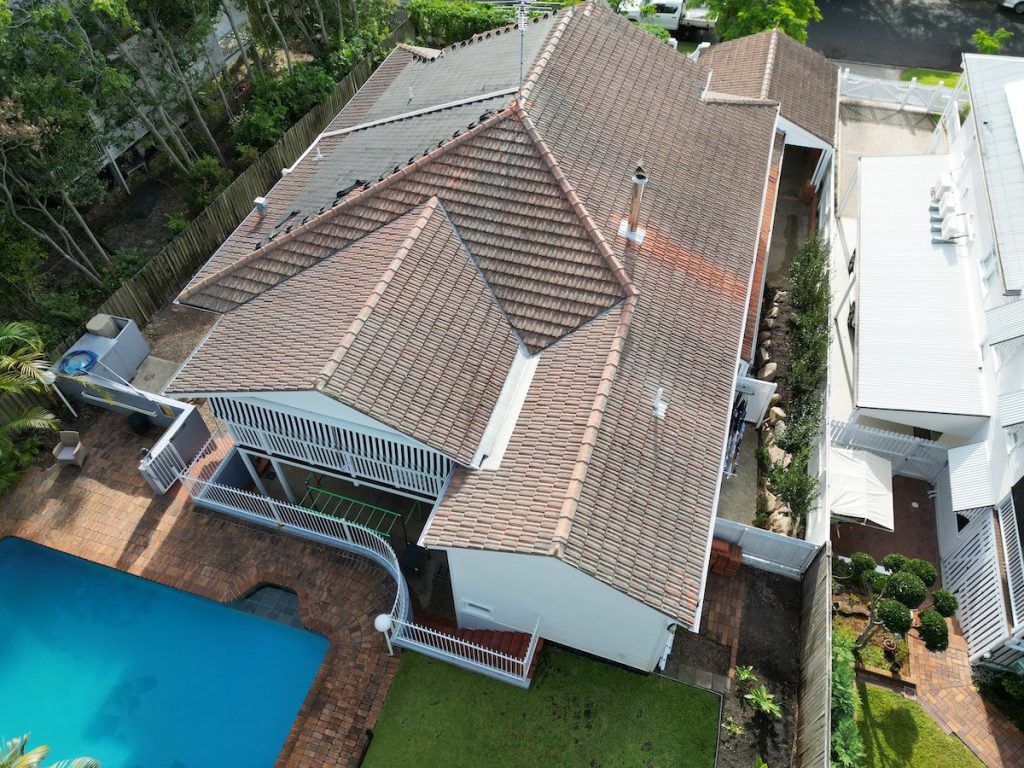
If your house was built before 1990 and hasn’t been re-roofed since then, then chances are there is asbestos in your roof. There are thousands of residential buildings in South East Queensland where the roofs are made up of asbestos-cement sheets that have long surpassed their intended lifespan. Asbestos-cement sheets were affordable and resistant to fire, and could be purchased from almost any building supplies shop, making them the go-to option for roofing by Australian builders during the 1940s all the way until the mid-1980s.
But actually detecting asbestos in your roof requires an understanding of the age of the building and knowledge of a few visual indicators, followed by professional testing to confirm what you’re dealing with.
If you’d prefer to avoid all the guesswork and let someone who has inspected thousands of asbestos-cement roofs do the work for you, then AMJ Metal Roofing can inspect your roof. We offer roof inspections across Brisbane, the Gold Coast, Sunshine Coast, Ipswich and Toowoomba.
Check when your home was built or last re-roofed
The quickest method of determining whether your roof has asbestos materials is its age. Find the property’s contract of sale or even council documentation. Approval documents for a property will give the construction date. Any property that was constructed prior to 1990 means that there were asbestos-containing materials used in the construction process, most probably in the roof itself.
Should you have any roof work done in subsequent years after the initial construction date, then that would take precedence over the construction date. A house that was built in 1975 but whose roof was replaced in 2005 using Colorbond would mean that the roof no longer has any asbestos materials (though there could be asbestos elsewhere). On the other hand, a house that was built in 1988 and not subsequently modified could well have asbestos in the roof.
Why the 1990 cut-off matters in Australia
Australia banned the manufacture and use of asbestos products in stages. Asbestos cement sheets used in roofing were phased out in the latter stages of the 1980s. The use of all asbestos-containing products was officially banned as of December 2003. However, in reality, the cut-off date for roofing purposes is much earlier. By then, the production of asbestos roof sheets had ceased, and builders had started using metal and fibre cement sheets as substitutes.
However, the problem arises because asbestos-containing material could be used even after the date when production ceased. This implies that although asbestos was not being produced in 1991 and 1992, buildings erected at that time may contain asbestos roof sheets. Such cases are rare, but it’s why the 1990 line is a guide rather than a guarantee.
Renovations and extensions that may have introduced asbestos later
This is what throws people off their guard. Your main house may have been constructed back in 1995 without having any asbestos at all. But when an earlier owner added a carport or patio using leftover building materials from the late 1980s or even a granny flat using stock items to build an inexpensive extension, these structures could have asbestos, even if the main house is free of it.
This occurs more frequently than people think, especially with houses that underwent several renovations during the 1970s until the early 1990s. Asbestos cement flat sheet roofing material on patios is among the most frequent instances encountered by AMJ’s team during our inspection process. Homeowners tend to assume that the entire property is free of asbestos since the roof is made of metal, when, in reality, it is the carport or covered walkway that should give them pause for concern.
Then there’s garage roofs. It might be the case that if the garage is a separate building from the home, then it might not be made of the same material at all. This applies to garden sheds, laundry lean-tos, and any additional buildings that have been constructed on a piecemeal basis over time.
Before any work on the roof can begin, all structures within the property need to be examined individually. It’s easy to assume that everything in the yard is made of the same material simply based on the appearance of the roof, but asbestos exposure often occurs accidentally. AMJ’s roof inspections in Brisbane cover every structure on the property for exactly this reason.
Visual signs of asbestos cement roofing
You can’t confirm asbestos by looking at it. But there are visual clues that should raise your suspicion enough to get it tested.
Profile, texture and finish
Asbestos cement roofing in Australia was almost always corrugated sheeting. It resembles corrugated metal from afar, but the distinctions can be seen from closer inspection. The surface of asbestos cement sheets is chalky and dull, unlike metal, which is glossy. The texture is usually coarse or gritty, reminiscent of sand and concrete.
The surface ages poorly and unevenly. There will be irregular patches of dark discolouration, as well as moss and lichen growths, especially on southward-facing parts of the roof that remain wet. Elsewhere, there would be remnants of paint peeled off, revealing the grey cement beneath. Corrugations tend to break down easily and become brittle around the ridges and joints between sheets. These are among the signs your home needs a roof replacement that shouldn’t be ignored.
How asbestos roof sheeting differs from metal roofing
Although corrugated asbestos and metal roofs may appear the same at street-level view, there are some key differences. Metal sheets reflect light and have a reflective finish, even if they are worn and faded, whereas asbestos sheets absorb light and lack a reflective finish.
You can also tap the surface to determine whether it is metal or asbestos. Metal sheets produce a ringing sound. Tapping asbestos cement produces a dull noise, much like tapping a chunk of concrete. Another way to determine if your roof is made of metal sheets is to check for visible screw fixings. Asbestos sheets, especially older ones, usually used nails or hook bolts, which fit flush into or below the roof surface.
If your roof is cracked, and you can see a layered and fibrous interior, you can be certain that your roof is made of asbestos cement.
Product names and markings to look for
Asbestos roof sheeting often bears stamps on the underside of the sheet or printed labels on its edges, which indicate the name of the manufacturer. You can check the name of the brand on the underside of the sheeting if you have safe access to the roof cavity and can view the underside of the sheeting. Some common asbestos-containing brands include “Super Six”, “Hardiflex”, “Hardie” and “Wunderlich”.
All labelled sheets do not necessarily contain asbestos; the James Hardie company stopped producing asbestos-containing products around the late 1980s to early 1990s and replaced them with asbestos-free products. This means a sheet bearing the brand “Hardie” manufactured after 1987 could be fibre cement rather than asbestos cement.
Other places asbestos hides beyond the roof
Should you have asbestos in your roof, chances are high that you will find more asbestos materials within your property. This is because the asbestos roof sheet manufacturers also made many other building products using the same raw material.
Eaves, soffits and ridge capping
Eaves lining is among the most commonly ignored sources of asbestos around Queensland homes. The conventional choice for lining eaves in homes constructed between the 1950s and 1980s was flat asbestos cement sheets. In addition, asbestos roof capping will usually be asbestos cement sheets that have been moulded to fit the shape of the roof. Removal of an asbestos roof by AMJ usually involves removal of the asbestos roof capping and barge boards, as well as the eaves linings, due to similarities in composition. You can learn more about how that full process works on AMJ’s asbestos roof replacement page.
Wet areas, wall cladding and fences
Asbestos-cement sheeting was widely used for wall linings in bathrooms, laundries, and kitchens behind splash boards. Vinyl tiles installed prior to 1990 could also have asbestos fibres, especially the 9-inch square tiles that gained popularity during the 1960s and 1970s. On the exterior, asbestos-cement sheeting was used for wall cladding in weatherboard-type houses and fences. Asbestos-cement sheeting was also used to insulate water pipes. In older homes, hot water pipes often had either white or grey insulation wrapped around them, which could be asbestos insulation.
Why you cannot confirm asbestos by sight alone
Asbestos cement sheeting for use in roofing consists of asbestos fibres which have been bound tightly in a cement mixture. These asbestos fibres are not visible with the naked eye; asbestos cement sheeting is indistinguishable from regular cement sheeting unless a specialist looks at them through a microscope.
That’s why any action based on any assumptions regarding the composition of the sheeting is dangerous. If you assume that it contains asbestos fibres and then find out it doesn’t, you might be paying for unnecessary removal services. On the other hand, if you decide it doesn’t contain asbestos while it really does, you could inadvertently release these fibres into the air. Professional testing is the only way to get a definitive answer.
How professional asbestos testing works
Laboratory analysis is the only way to get a definitive yes or no. This isn’t a DIY job.
What happens during a NATA-accredited lab test
The process involves a qualified assessor collecting a very small quantity of the suspected substance, usually a golf ball-sized sample. This is then packaged in a sealed container, labelled, and sent to a laboratory accredited by NATA (National Association of Testing Authorities). Using either polarised light microscopy or transmission electron microscopy techniques, the laboratory is able to establish if there are any asbestos fibres within the sample and, if there are, what type they are.
This process takes between two and five working days. The lab will then give a report, which specifies the presence and type of asbestos found (if any was found) in the sample. Crocidolite is not as common as chrysotile and amosite. Chrysotile is the most common form of asbestos discovered in roofs in Australia.
Why DIY testing kits are not worth the exposure risk
Asbestos sampling kits are available for purchase online. These come with a sampling bag and instructions. There is also a prepaid mailing package to ship your sample to the laboratory. The lab tests are identical to what a professional will do. The issue lies in the sample itself.
Obtaining samples from asbestos cement sheeting involves taking a chip out of the sheet. This produces dust particles. In the case where the sheeting does indeed contain asbestos, the act of removing a sample means producing asbestos fibres that could harm you directly in close proximity. A certified assessor uses breathing equipment as well as wetting down the area before sampling. They are trained to remove the smallest sample in an effective manner. You likely do not have the equipment or skillset to do this.
The savings of $50 when using a DIY kit over hiring an assessor isn’t worth the risk. No amount of asbestos fibre exposure is safe.
What not to do if you suspect asbestos on your roof
Disturbing the material before you have a confirmed test result is the single biggest risk homeowners take with older roofs.
Why pressure washing an asbestos roof is illegal in many areas
This is among the most common mistakes made by homeowners with their old roofs, as well as the most dangerous one. Their roof is looking shabby, moss is growing on it, and the easiest solution appears to be just pressure washing it. But in case that roof happens to be asbestos cement, it is an illegal procedure according to occupational health and safety rules in Queensland. The logic here is simple. A high pressure of water being applied to weathered asbestos sheeting releases fibres straight into the atmosphere. The older and more fragile those sheets become, the more likely they are to emit fibres.
According to the Work Health and Safety Regulation 2011 in Queensland, anything associated with working with asbestos is considered asbestos-related work. So, pressure washing an asbestos roof is asbestos-related, and requires a license from a qualified asbestos removalist. Violation of those rules can result in fines ranging from several hundreds to thousands of dollars.
The AMJ team conducts regular checks at locations where a homeowner or an unauthorised cleaner has performed a pressure wash of asbestos roofing sheets without knowing what they were working on. The damage will be evident from the first look, because the top layer will have been reduced to nothing but cement fibres.
Everyday activities that can release asbestos fibres without you realising
Pressure washing is just one danger, but there are many others. Drilling holes for mounting a TV antenna or satellite dish in asbestos cement sheeting will expose fibres around the drilling point. This is true for installing brackets for solar panels, as well.
Just walking on an old asbestos roof is enough to crack brittle asbestos sheets below your feet. Gutter cleaning can pose a risk because pieces of asbestos sheets that have been gradually breaking up are detached by your hand. Lastly, sanding old paint on asbestos cement roof sheeting also poses a threat to people’s health.
The common thread here is mechanical disturbance. Breaking, chipping, grinding, sanding, drilling or pressure washing the asbestos cement sheeting is all bound to release dangerous fibres. The key lies in leaving an asbestos cement matrix intact, so the fibres are tightly held together, and no danger occurs.
Health risks of disturbing asbestos roofing
When asbestos particles are airborne, their effects occur on a microscopic level in the lungs. The asbestos particles are microscopic in size and cannot be seen by the human eye. And, once they enter the lungs, they remain there for life.
How asbestos fibres damage lung tissue over time
Asbestos fibres, when breathed in, become embedded deeply into the lung tissues, where the body is unable to dissolve them or get rid of them in any way. With time, as these asbestos fibres accumulate inside the lungs, there is an inflammatory reaction that occurs. This is a reaction by the body’s immune system to the asbestos fibres that leads to a condition known as “asbestosis”, which results in scarring of the lungs.
Exposure to asbestos is also a proven cause of lung cancer and mesothelioma, which is cancer of the membrane lining in the chest and abdominal cavities, a condition that develops due to breathing in asbestos fibres. It only requires minimal exposure for a person to develop either of these conditions.
The latency period most people do not expect
Mesothelioma usually manifests itself about 20 to 50 years after first being exposed. The development of asbestosis and lung cancer due to asbestos inhalation could take anywhere between 10 to 40 years before someone starts showing any signs.
This latency period is what makes asbestos so deceptive. A house owner having washed their roof by pressure washing in 2005 and feeling fine, would never correlate that to a disease in 2035.
Your options once asbestos is confirmed
Once you have confirmation that you are dealing with asbestos, you will have time to consider whether to remove or leave it, based on how the roof is and your plans for the building.
When leaving it in place is reasonable
In the event that the asbestos cement roofing is intact with no signs of cracking or extensive weathering, and there are no intentions to renovate or modify it, it can be left as is, although for only a short period of time. Non-friable asbestos becomes a low-risk factor if it remains untouched, since the fibres are bound within the cement.
It should be noted that even though the asbestos roof cement may be in “good condition,” this does not last forever. In Queensland, the asbestos cement roof will continue to deteriorate due to the climate. Leaving it as is means having to continually monitor it.
When replacement is the safer long-term decision
In cases of cracking and heavy weathering, along with erosion of the sheets, replacement becomes a more appropriate alternative. This is true even for any kind of work that involves drilling and cutting, as well as walking on the roof. Replacement of the asbestos roof with Colorbond or Zincalume entails some costs upfront, but it eliminates the ongoing risk and the restrictions that come with living under a material you can’t touch.
As AMJ’s experience shows, replacement of asbestos roofs becomes inevitable for most of our clients when they understand that they will never install solar panels, fix a leaking roof without fibre release, mount any antennas or dishes, and will soon face problems with getting insurance for this type of roof.
Our guide to asbestos removal and replacement costs breaks down what influences the price so you can plan ahead.
Removal rules in Australia for areas over 10 square metres
Any asbestos removal in Queensland above 10 square metres requires a Class A (friable) or Class B (non-friable) license holder to undertake the activity. Roof replacement is considered Class B removal, since the existing roofing sheeting is considered non-friable asbestos, which means that the fibres are bound into the cement matrix. This is not friable, and therefore it does not exist in a dust or powder form.
The asbestos removalist should inform Workplace Health and Safety Queensland about the intended asbestos removal at least five business days prior to the work. They need to prepare an asbestos removal control plan detailing the method of asbestos removal, wetting, wrapping, transport, and disposal at a licensed facility. Air monitoring might be necessary, too, depending on the job requirements.
AMJ coordinates the entire project, including engaging asbestos removalists and notifying the authorities of the operation. The asbestos removal process takes place, and then the roof replacement with either Colorbond or Zincalume metal roof sheets occurs. All the generated waste is taken to the appropriate disposal facility. Scaffolding and edge protection are included in each project.
What a roofing company actually sees during asbestos roof inspections
A good chunk of information on asbestos roofs available online has been provided by government health officials and other bodies. The information is correct, but tends to be from the regulatory point of view. The knowledge that a metal roof expert acquires after visiting asbestos roofs in many buildings gives a different perspective on things.
Hidden damage that homeowners commonly miss from the ground
An asbestos roof viewed from ground level can appear fine. The corrugations are all there, the colour is uniform, and there does not seem to be any visible tears. However, once the AMJ team puts up the scaffolding, another reality emerges.
The first problem is one that is often overlooked; hairline cracks on the peaks of the corrugations due to thermal expansion. The cracks are invisible at ground level, but allow water to seep through during torrential rainfall. Over time, that moisture reaches the timber battens and rafters underneath, and by the time the homeowner notices a ceiling stain, the structural timber may have been rotting for years.
Then there is edge deterioration. The cut edges of asbestos cement sheets, which have been cut to install the sheets originally, wear out at a quicker rate than other parts of the sheet. As a result, the dust settles in your gutters or rainwater tanks. If you collect rainwater from an asbestos roof, then you could be collecting asbestos dust along with your water.
Fixings have their own tale to tell. In due course, the original roof fixings, like nails or hook bolts, will deteriorate. As they become loose, they will allow the lifting of sheets when there is a breeze blowing strongly. Each time that happens, some deterioration occurs at the fixing holes and the holes get bigger, while some of the sheet breaks off. If you’ve noticed any of these issues, AMJ’s team can assess whether roof repairs or a full replacement is the right path.
How Queensland weather accelerates asbestos roof deterioration
The tropical environment of Brisbane causes considerable deterioration to asbestos cement roofs. The high ultraviolet radiation, humidity, cyclical storms, and changes in temperature cause accelerated degradation of the cement component more rapidly than would be expected in a cooler, dryer climate.
The main factor responsible for this is UV radiation. The ultraviolet rays cause rapid oxidation and decay of the cement binder at the surface of the material. This gradually results in the wearing off of the surface coating, exposing the fibres below. If you run your fingers on the surface of an aged asbestos roof, you will probably feel some powder-like substance. That powder consists of worn-off cement particles that may contain loose asbestos fibres.
Mechanical strain is another factor that comes into play in the form of the storm season in Queensland. The hail damages the brittle sheets. The rain driven by the wind pushes water through cracks formed by thermal expansion and contraction cycles. The wind from a cyclone is strong enough to rip off and smash the sheets against the frame of the roof. If a storm has already damaged your roof, AMJ handles storm damage and insurance repairs and can manage the claims process on your behalf.
Moisture will encourage biological growth, where moss and lichens will retain moisture in the roof sheeting, causing the algae to grow. This causes faster degradation of the cement binder. Roof sheets on the southern part of the roof that remain wet, even during the colder months, are usually the first parts to deteriorate.
Based on observations of thousands of asbestos roofs around the area, AMJ has found that while some roof sheets may be good for another 10 years in other regions, they will already have a very short lifespan of 40 to 50 years in South East Queensland.
Get your roof assessed by a specialist
If anything we’ve detailed so far sounds like your roof, the next step is an inspection. Guessing doesn’t protect your family, and putting it off doesn’t make the problem smaller.
What to expect from an AMJ roof inspection
AMJ provides professional roof inspections across the greater Brisbane region in South East Queensland. The process starts with a quick call to 1300 12 ROOF (1300 127 663) to arrange an on-site assessment. One of our experienced team members will then inspect your roof using appropriate safety equipment, including scaffolding where required. During the inspection, they’ll assess the roof sheeting, fixings, flashings, guttering, and structural timber before providing an honest, detailed overview of their findings.
In case your roof has asbestos, we will offer advice on how to proceed with testing, removal, and replacement of the roof. In cases where customers decide to replace their roofs with Colorbond and Zincalume, the service comes with a 10-year warranty, while the manufacturer’s warranty covers the roofing product for 25 years. All asbestos waste materials will be removed and disposed of in a licensed facility. Scaffolding and edge protection is included in all jobs.
AMJ holds QBCC Licence 120 2330 and has completed over 7,000 re-roof projects. If your roof needs replacing, you’ll know exactly what’s involved and what it costs before any work begins. AMJ keeps you informed on timing throughout. You can also read AMJ’s breakdown of roof replacement costs to understand what factors influence pricing.
FAQs
Can asbestos roofing be safe if left undisturbed?
Yes, at least for a short period of time. Asbestos roof sheeting that has not been damaged in any way will present no risk in the immediate sense, since the fibres would be firmly attached to the cement compound. However, it should be noted that this type of roofing deteriorates over time and in the heat in the Queensland climate.
How much does it cost to replace an asbestos roof with metal in Brisbane?
This depends on many factors, including roof size, roof pitch, accessibility, quantity of asbestos to be removed, and the Colorbond roof style and colour chosen. As a general guide, residential roofs that require replacement from asbestos to metal roofs in the Brisbane region can cost from $30,000 to $45,000. The costs quoted are inclusive of all work done.
Does my asbestos roof need to be removed before solar panels can be installed?
Yes, usually. The mounting process for solar panels involves drilling mounting brackets through the roof sheathing, which causes the release of fibres from the asbestos sheeting. Any professional solar panel installer should decline installing your solar panels on an asbestos roof. Instead, it is common practice to replace your asbestos roof with a metal one before installing your solar panels so that your roof and panels will both last the same length of time.
Will my home insurance cover asbestos roof replacement?
If the reason for asbestos roof replacement is due to damage caused by storms or any other covered reason, most insurance companies will cover the costs, which include the cost of safely removing asbestos. AMJ works closely with big insurance companies, and we handle claim procedures all the time. If the replacement is a proactive measure based on the age or quality of the roof, then that is a personal expense.
How long does an asbestos roof replacement take from inspection to completion?
An asbestos roof replacement job typically lasts from two to five days for an average-sized house. The total duration of the process from the point of inspection to the point of completion can be anywhere between two and four weeks, including the site measure, asbestos removal notification (notice of five working days to WHSQ is required by law), and procurement of materials.


